
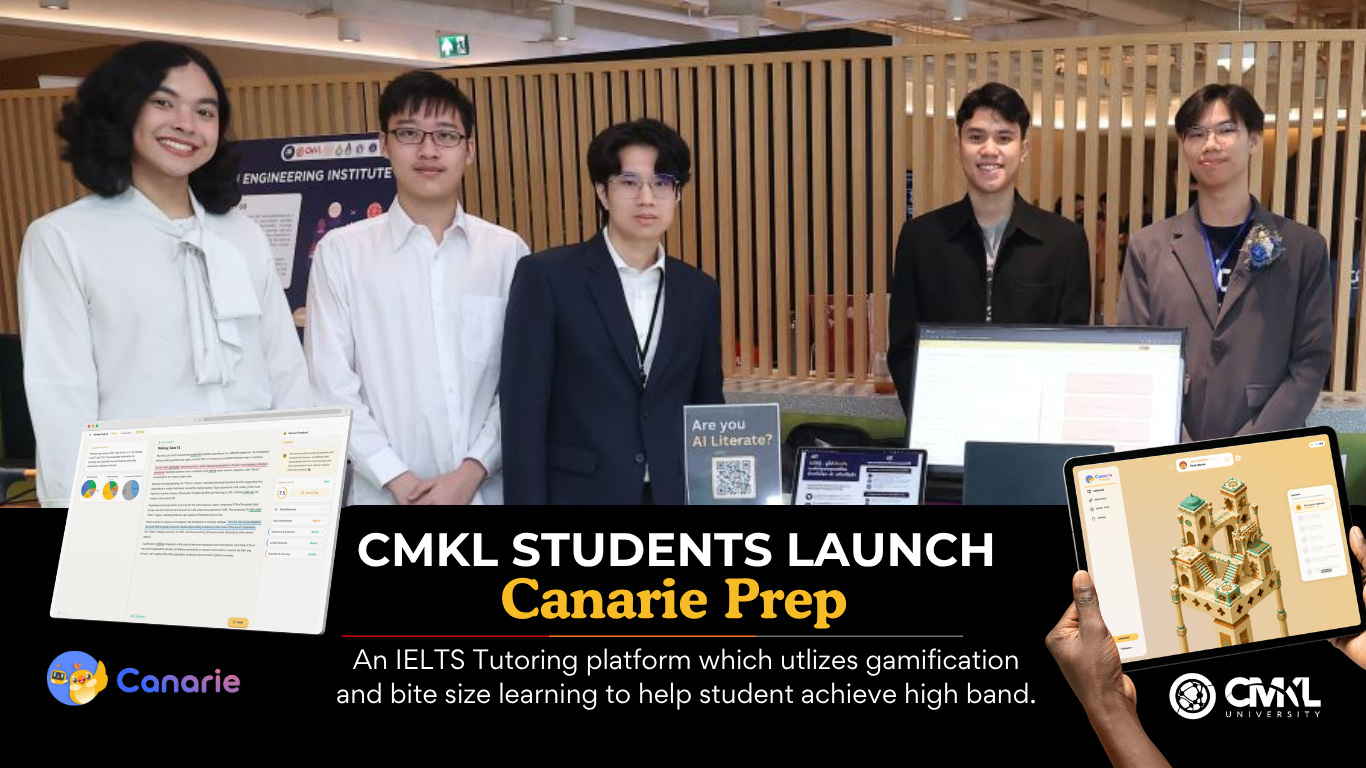
What began as an undergraduate capstone project has grown into Canarie, a revenue-generating AI teaching assistant startup designed to support educators, reduce administrative workload, and help students learn beyond the classroom.
Built by graduates from Computer Innovation Engineering (CIE), KMITL, and CMKL University’s AI & Computer Engineering (AiCE) program, Canarie reflects CMKL’s approach to AI education: students do not only study emerging technologies, they build practical systems that address real problems in education, industry, and society.

Canarie is designed to act as a seamless AI co-teacher. The platform helps educators automate time-consuming tasks such as administrative work and lesson preparation, while providing students with 24/7 personalized tutoring aligned with their specific curriculum. By offering immediate, context-aware support inside and outside the classroom, Canarie aims to help teachers focus more on high-impact instruction and help students continue learning independently.
The founding team includes Chakrit Ritthakananon, Computer Innovation Engineering (CIE), 2021 cohort, Chief Executive Officer; Siraphop Mukdaphetcharat, Computer Innovation Engineering (CIE), 2021 cohort, Chief Financial Officer; Phanuruj Sotthidat, Computer Innovation Engineering (CIE), 2021 cohort, Chief Technology Officer; and Paksaran Kongkaew, AI & Computer Engineering (AiCE), 2022 cohort, Chief AI Officer.

The venture began during the founders’ undergraduate years as a capstone project led by Chakrit and two colleagues from his program, together with Paksaran, who was beginning her first year at CMKL in 2022. Under the mentorship of Dr. Akkarit Sangpetch, the project developed from an academic exploration into a serious business plan. After Phanuruj and Siraphop joined the team in 2024, Canarie continued to mature as both a technical product and a venture. In 2026, the team decided to officially spin off the project into a standalone company.
Canarie has already moved beyond the prototype stage. The team reported that the platform is now revenue-generating and has registered 200 beta users within three months, indicating early interest from learners and educators seeking AI-supported learning tools.
For the student founders, building Canarie during their university years created a learning experience that extended far beyond the classroom. The team encountered technical challenges, industry vocabulary, business questions, and product decisions that they may not have discovered through coursework alone. Access to faculty members from diverse backgrounds also gave them opportunities to ask questions, test ideas, and connect their work to real-world applications.
“Starting this journey early in our university years allowed us to learn by doing,” the team shared. “We often had to tackle challenges beyond the standard curriculum, from unfamiliar technical concepts to industry terms we had never encountered before. Having access to faculty from diverse backgrounds meant we could keep learning every day, and it opened doors to opportunities we never imagined when we first started.”
Built on the belief that “the best tutor guides the way, but never walks it for you,” Canarie represents the kind of student-led innovation CMKL aims to cultivate: AI systems that are technically grounded, socially relevant, and designed for real-world use.
As demand grows for responsible and practical AI adoption in education, Canarie points to a broader opportunity for Thailand’s innovation ecosystem. By combining AI engineering, educational insight, and entrepreneurial execution, the team is contributing to a future where technology strengthens both teaching and learning, while preparing students to become builders of the next generation of AI-driven solutions.
Demo Video: link
Built from a capstone project. Powered by AI learning support. Scaled into a student-led EdTech startup
#BuiltHereCMKL
Website:https://canarie.tech/en
Contact: [email protected]


Flooding is a recurring challenge in Bangkok, affecting mobility, safety, business operations, and daily life. Flood risk is shaped by many factors at once: rainfall, terrain, drainage systems, canal proximity, road conditions, and local reports from people on the ground.
Read more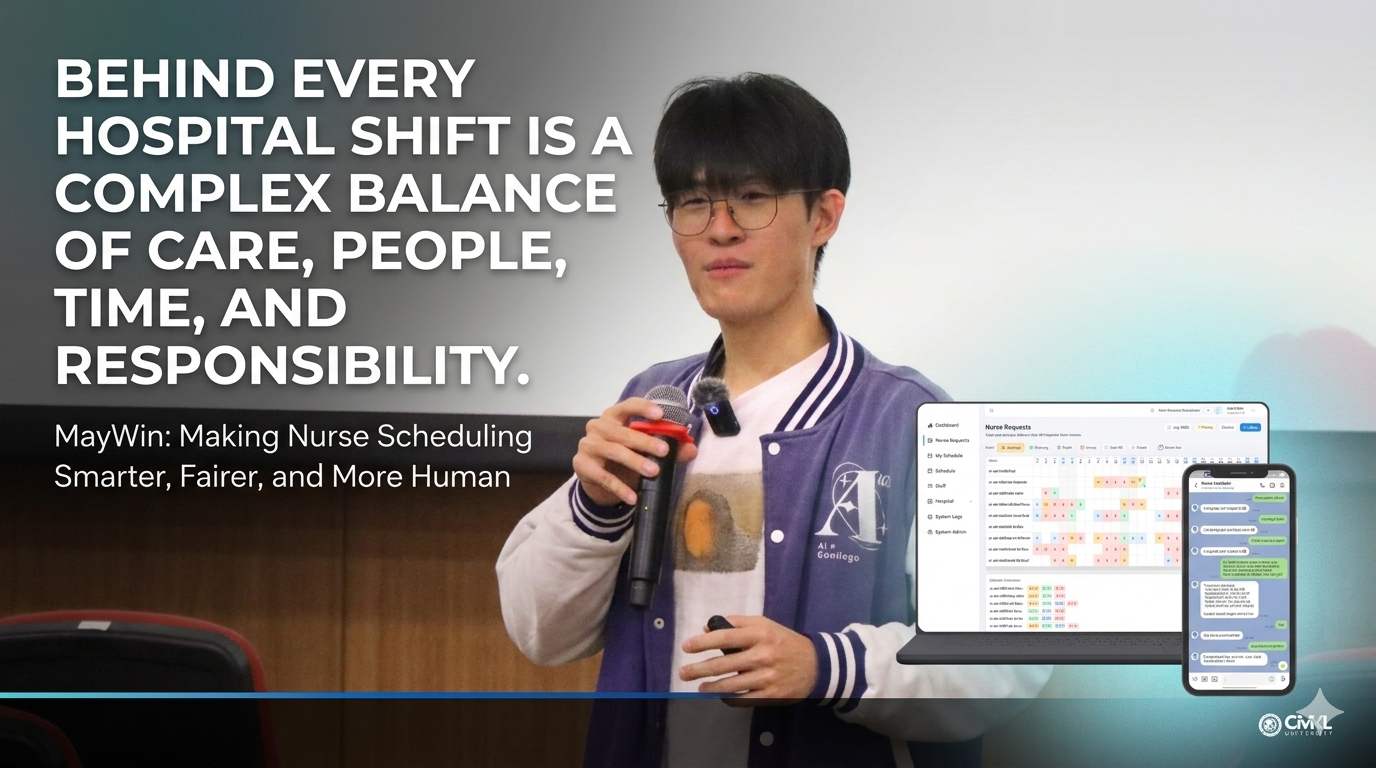
Hospital nurse scheduling is a high-stakes operational problem. A good schedule must provide adequate staffing, respect labor rules, balance workloads, and consider individual preferences. When done manually, the process can be time-consuming, stressful, and difficult to make fair.
Read more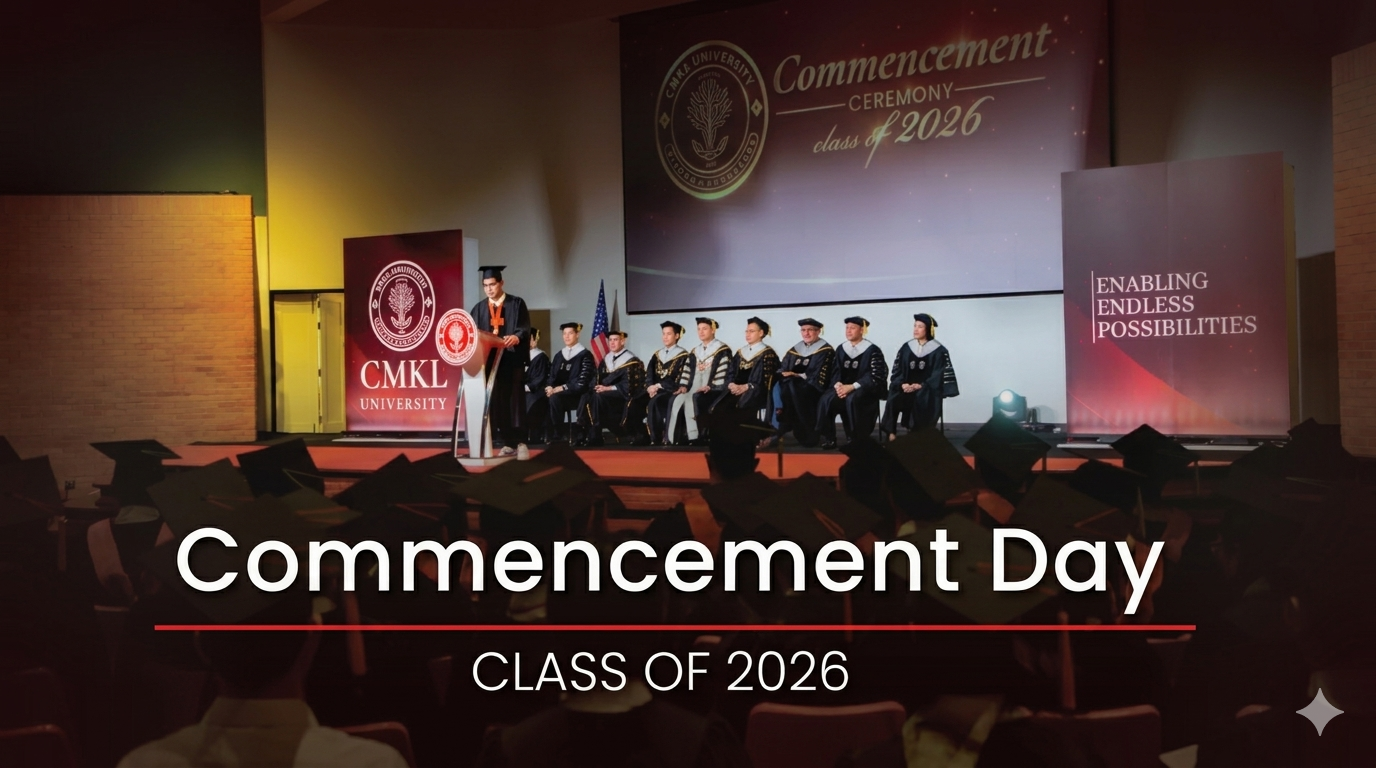
Graduates from CMKL’s technology, AI, engineering, and innovation programs were honored for their academic achievement and readiness to contribute to Thailand’s future workforce and innovation ecosystem.
Read more